

What is the output quality standard of a corrugated cardboard production line?
As a trusted supplier of corrugated cardboard production lines, I understand the pivotal role that output quality standards play in the industry. These standards not only define the product's performance but also impact the overall success of businesses relying on corrugated cardboard for packaging and other applications. In this blog, I'll delve into the key aspects of the output quality standard of a corrugated cardboard production line, offering insights that can help you make informed decisions when it comes to purchasing and operating such equipment.
1. Physical Dimensions
One of the fundamental quality standards for corrugated cardboard is its physical dimensions, including length, width, and thickness. Precise dimensions are crucial as they ensure the cardboard fits seamlessly into packaging machinery and meets the requirements of end - users.
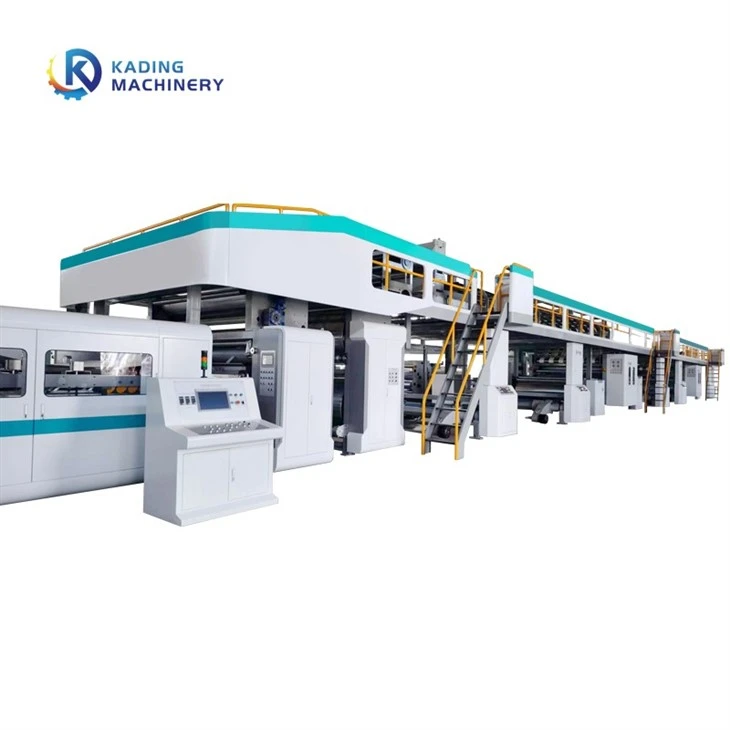
The length and width of corrugated cardboard sheets should adhere to the specified tolerances. For example, in most cases, the tolerance for length and width might be within ±1 - 3 mm, depending on the industry and customer requirements. A production line with advanced cutting and sizing mechanisms can achieve such high - precision dimensions. Our High Speed 3/5/7 Ply Corrugated Cardboard Production Line is equipped with state - of - the - art cutting systems that can accurately cut the cardboard to the desired dimensions, minimizing waste and ensuring consistent quality.
Thickness is another critical dimension. Different applications require different thicknesses of corrugated cardboard. For light - duty packaging, thinner cardboard may suffice, while heavy - duty applications demand thicker and more robust cardboard. The production line should be able to produce cardboard with a consistent thickness, with a tolerance typically within ±0.1 - 0.3 mm. This consistency is achieved through precise control of the corrugating rollers and the pressure applied during the production process.
2. Corrugation Quality
The corrugation is the defining characteristic of corrugated cardboard, and its quality has a significant impact on the cardboard's strength and cushioning properties.
The shape of the corrugation is a key factor. There are different types of corrugation profiles, such as A, B, C, E, and F flutes. Each profile has its own unique properties, with larger flutes providing more cushioning and smaller flutes offering better printability. The production line should be able to form the corrugation accurately, with uniform flute height and pitch. Any deviation in the flute shape can lead to reduced strength and inconsistent performance.
The bond between the linerboard and the corrugated medium is also crucial. A strong bond ensures that the layers of the cardboard stay together under stress. The bonding strength is typically measured in terms of the force required to separate the linerboard from the corrugated medium. A high - quality production line, like our Corrugated Board Production Line, uses advanced adhesive application systems to ensure a firm and durable bond, resulting in cardboard that can withstand handling and transportation.
3. Strength and Durability
Corrugated cardboard needs to have sufficient strength and durability to protect the products it packages. Two important strength properties are bursting strength and edge crush strength.
Bursting strength refers to the maximum pressure that the cardboard can withstand before bursting. It is measured in pounds per square inch (psi) or kilopascals (kPa). The bursting strength of corrugated cardboard depends on factors such as the quality of the paper used, the corrugation profile, and the overall construction of the cardboard. A well - designed production line can produce cardboard with a high bursting strength by carefully selecting the raw materials and optimizing the production process.
Edge crush strength (ECT) measures the ability of the cardboard to resist crushing when pressure is applied to its edges. This property is particularly important for stacked or palletized products. A higher ECT value indicates that the cardboard can better withstand the weight of other packages on top of it. Our 5 Layers Corrugated Cardboard Production Line with Production Management System is capable of producing cardboard with excellent edge crush strength, thanks to its advanced manufacturing techniques and quality control measures.
4. Printability
In today's competitive market, the ability to print high - quality graphics on corrugated cardboard is essential for branding and marketing purposes.
The surface smoothness of the linerboard is a key factor in printability. A smooth surface allows for better ink adhesion and sharper image reproduction. The production line should be able to produce linerboard with a consistent surface finish. Additionally, the cardboard should have good ink absorption properties to ensure that the printed colors are vibrant and long - lasting.
The flatness of the cardboard is also important for printing. Any warping or unevenness can cause problems during the printing process, such as misregistration or poor ink transfer. A high - quality production line incorporates processes to ensure that the cardboard remains flat and stable, making it suitable for various printing methods, including flexography and lithography.
5. Moisture Resistance
Moisture can significantly affect the strength and performance of corrugated cardboard. High moisture content can cause the cardboard to lose its stiffness and become weak, while low moisture content can make it brittle and prone to cracking.
The production line should be able to control the moisture content of the cardboard within an optimal range. This is typically achieved through a combination of drying and conditioning processes. By maintaining the right moisture level, the cardboard can retain its strength and durability, even in humid environments. Additionally, some applications may require the cardboard to have enhanced moisture resistance, which can be achieved through the use of special coatings or treatments during the production process.
Contact for Purchase and Negotiation
If you're in the market for a corrugated cardboard production line that meets the highest output quality standards, I invite you to get in touch. We are committed to providing you with the best - in - class equipment and comprehensive support to ensure your production operations are successful. Whether you have specific requirements or need guidance on choosing the right production line, our team of experts is ready to assist you.

References
- Packaging Machinery Manufacturers Institute (PMMI). (2023). Corrugated Packaging Industry Standards and Best Practices.
- TAPPI (Technical Association of the Pulp and Paper Industry). (2022). Standards for Corrugated Board Production.


